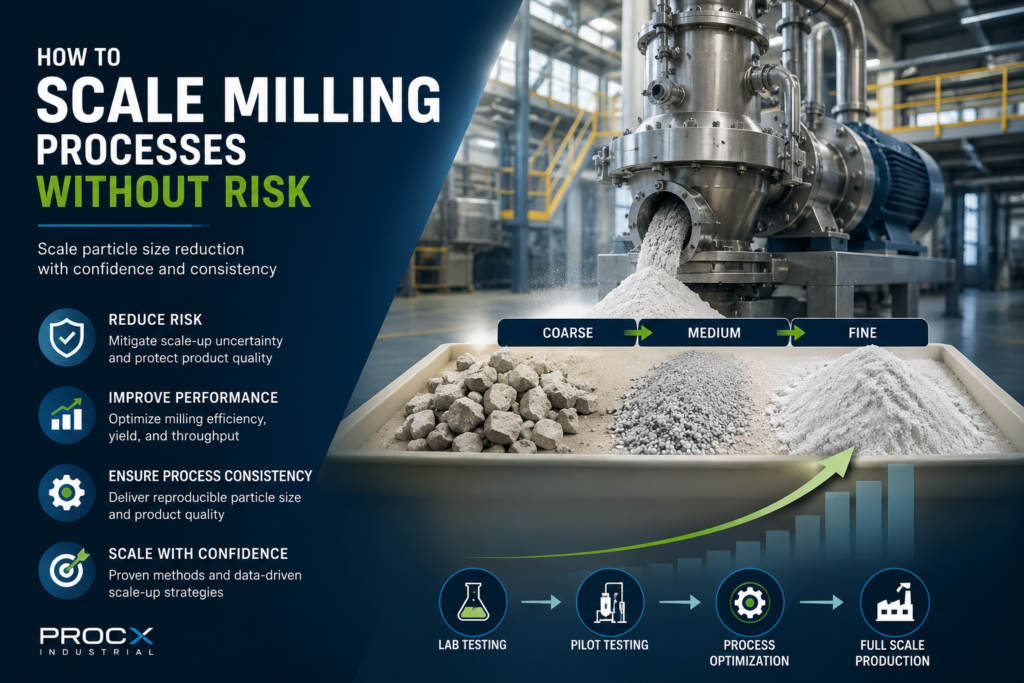
A milling line that performs well in pilot production can become unpredictable the moment throughput targets rise. Particle size starts to drift. Heat load increases. Feed behavior changes. Upstream and downstream equipment begin to expose constraints that were easy to miss at a smaller scale. That is the real challenge in how to scale milling processes – not simply making more product, but increasing capacity without giving up control, consistency, or uptime.
For manufacturers in regulated and performance-driven environments, scaling a milling operation is rarely an equipment-only decision. It is a system decision. Mill selection matters, but so do feed characteristics, material handling, automation, dust control, changeover requirements, thermal effects, and the behavior of every connected process step. If those interactions are not engineered together, the result is usually higher operational risk rather than higher usable output.
Why scaling milling capacity gets complicated
Milling processes do not scale in a straight line. Doubling motor size or increasing feed rate does not guarantee double throughput. As throughput rises, materials can behave differently inside the milling chamber. Residence time changes. Energy input per unit of product shifts. Screens, classifiers, and rotor configurations may no longer produce the same particle size distribution they delivered at lower volumes.
This is especially true for materials that are heat-sensitive, abrasive, hygroscopic, cohesive, or density-variable. A formulation that mills cleanly at moderate rates may smear, agglomerate, or degrade when pushed harder. In some cases, the mill itself is not the limiting factor. The bottleneck may be inconsistent infeed, poor surge control, inadequate aspiration, or insufficient discharge conveyance.
That is why capacity expansion should start with process definition, not equipment assumptions. The key question is not how big the next mill should be. The key question is what production outcome the scaled system must deliver – throughput, particle size range, yield, cleanliness, uptime, compliance, and flexibility across products.
How to scale milling processes by engineering the full line
The most reliable approach to how to scale milling processes is to treat the mill as one part of an integrated production platform. A larger or faster machine can help, but it will not solve instability elsewhere in the line. If the feed system is inconsistent, the mill sees fluctuating load. If material transfer is poorly matched, fines handling and product recovery suffer. If controls are fragmented across vendors, optimization becomes slower and troubleshooting becomes expensive.
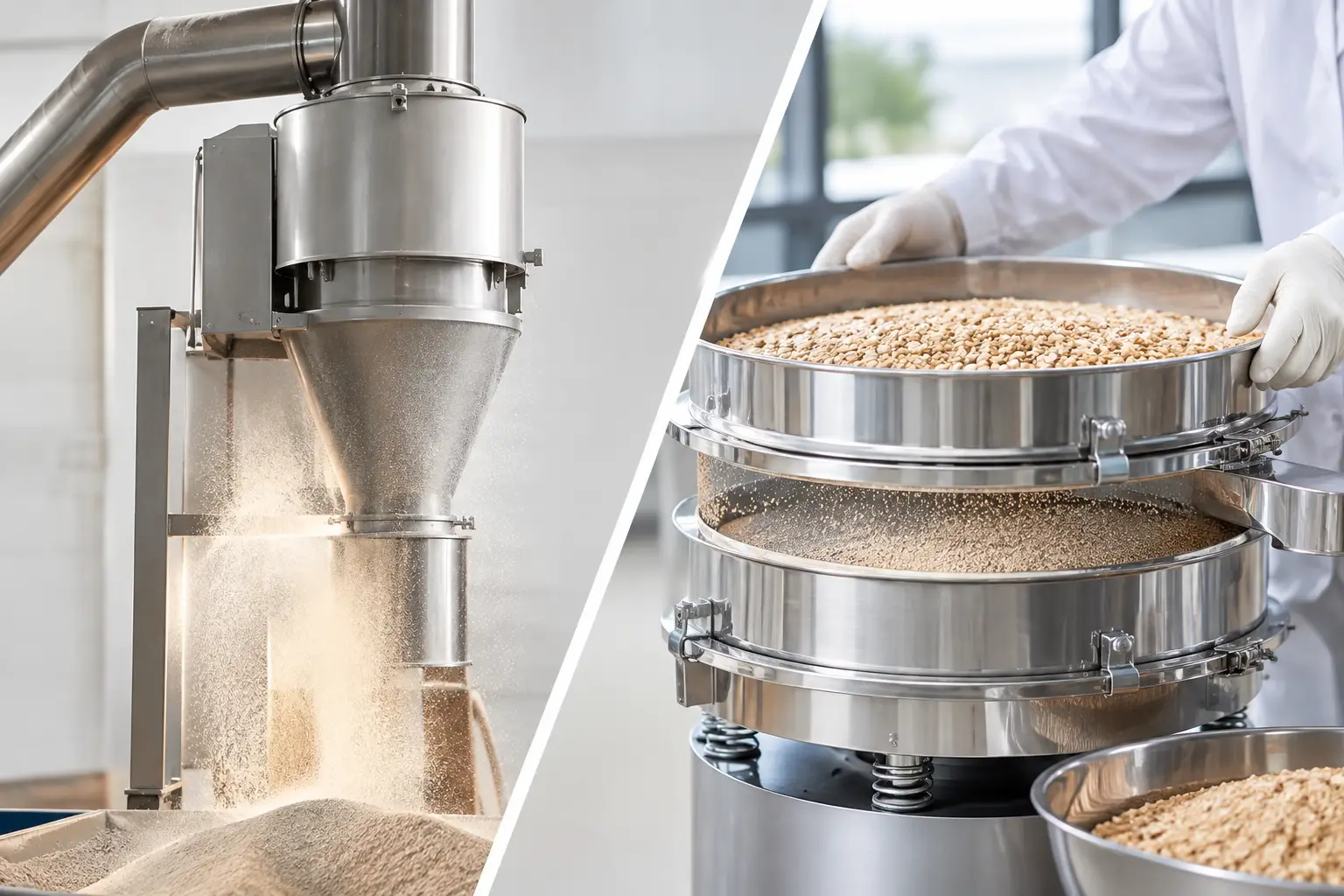
A scalable milling line starts with controlled material presentation. Bulk density, particle shape, moisture content, and feed consistency all influence mill performance. Feed hoppers, agitation, metering devices, and transfer methods should be selected to maintain a steady and predictable loading condition. Variability at the feed point is often mistaken for poor milling performance when it is actually a handling problem.
The next issue is process matching. Not every milling technology scales the same way. Impact mills, hammer mills, pin mills, cone mills, and air classifier mills each respond differently to changes in throughput, target fineness, and material behavior. A technology that is ideal for one product family may become inefficient when product mix expands. This is where process development matters. Scaling should be based on tested material behavior and targeted operating windows, not generalized nameplate assumptions.
Then there is the rest of the line. Milling throughput means little if mixing, extrusion, thermal processing, or packaging cannot absorb the increased volume. In many plants, the visible bottleneck changes after a mill upgrade. Capacity is added in one area, only to create starvation, surge conditions, or quality instability somewhere else. A system-level design prevents that shift by aligning buffer capacity, transfer rates, control logic, and line balance before installation begins.
Throughput is not the only metric that matters
Operations teams are often measured on output, but scaled milling performance should be evaluated against a broader set of criteria. Throughput without particle size consistency can create downstream quality losses. Throughput without thermal control can damage sensitive materials. Throughput without maintainability can increase stoppages and labor demand.
A better performance framework includes four questions. Can the scaled process hold the required particle size distribution? Can it maintain yield and minimize off-spec material? Can it run at target rates without excessive wear or heat generation? And can operators keep it stable across shifts, products, and production campaigns?
Those questions usually reveal whether the project is a true scale-up or just a larger machine purchase. In highly regulated sectors, they also affect validation strategy, documentation, and repeatability. If process behavior changes significantly at higher rates, quality and compliance teams will need evidence that the scaled line performs consistently under real production conditions.
Common failure points when scaling milling operations
The most common scaling mistake is specifying capacity in isolation. A mill may be sized for theoretical hourly output, while actual line performance is constrained by feed interruptions, dust collection limitations, or screen changes that take too long. The result is a line that looks sufficient on paper but underdelivers in production.
Another failure point is underestimating automation. As milling rates increase, the margin for manual correction gets smaller. Operators cannot react quickly enough to every fluctuation in feed, amperage, temperature, pressure, or downstream demand. Coordinated controls are essential for maintaining process stability. Integrated automation also matters during startup, recipe changes, alarm response, and data collection for process improvement.
Wear and maintenance are frequently overlooked as well. Some mills scale well in terms of throughput but create accelerated wear in contact surfaces, classifiers, liners, or screens. That may be manageable in low-volume production, but it becomes a significant cost and uptime issue at industrial scale. The right design depends on the material, expected operating hours, sanitation requirements, and how much planned maintenance the plant can realistically support.
Facility constraints can be just as limiting as process constraints. Utilities, explosion protection, cleanability requirements, access for maintenance, and available footprint all shape what a practical scale-up looks like. In brownfield environments, the technically ideal solution is not always the best one if it creates installation complexity, shutdown risk, or poor serviceability.
What an effective scale-up plan should include
A credible milling scale-up plan should begin with material and process characterization. That means understanding not only the target output, but also feed variability, critical quality attributes, thermal sensitivity, and how the material responds under different milling conditions. Pilot data helps, but it needs to be translated carefully into full-scale operating assumptions.
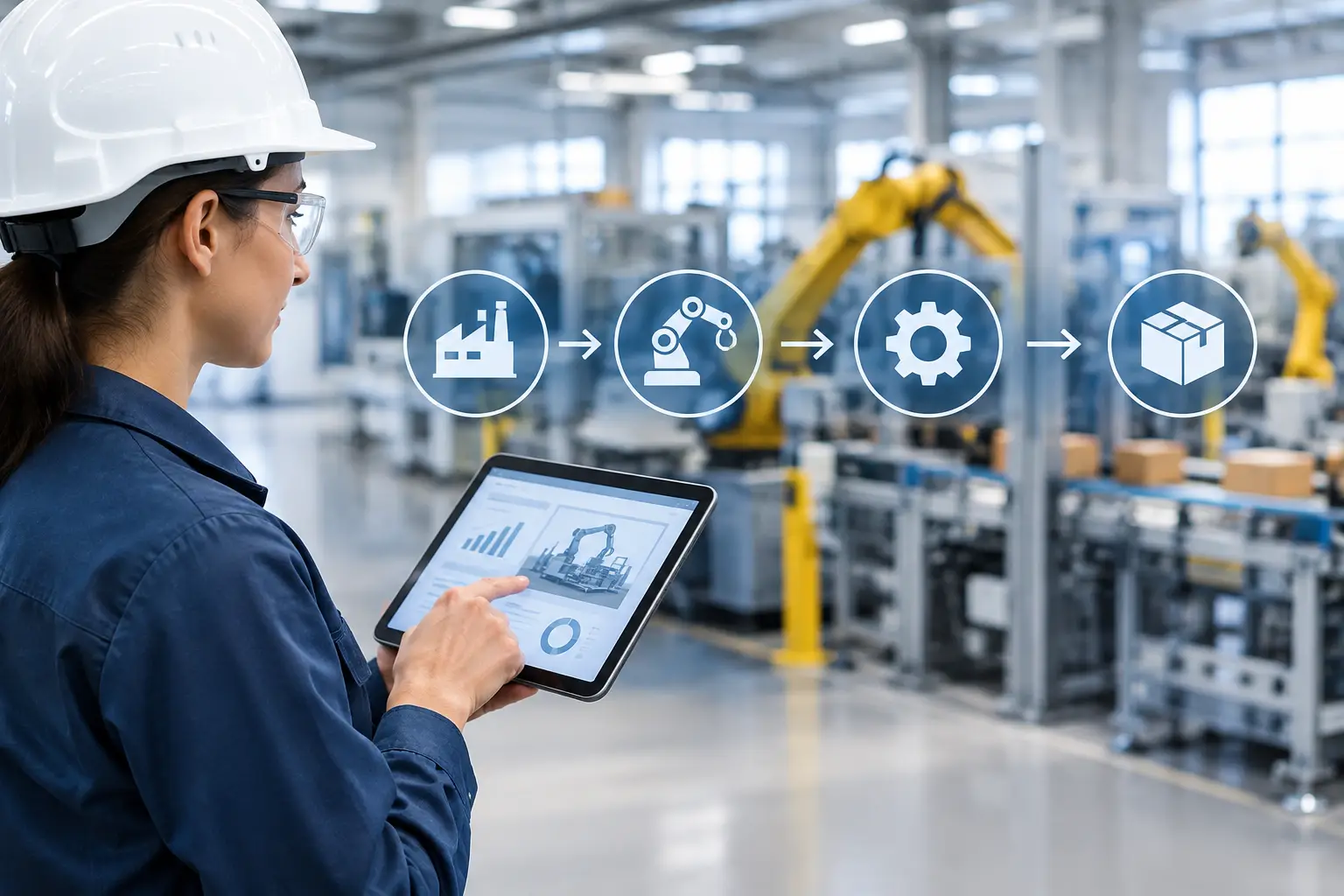
From there, the engineering effort should define the entire process path – raw material intake, metering, milling, transfer, collection, dust management, and the next unit operation. This is where single-source integration creates measurable value. When one engineering standard governs mechanical design, controls architecture, and system responsibility, there is less room for mismatched equipment behavior or accountability gaps during commissioning.
Controls strategy should be defined early, not added late. The line should be able to manage feed consistency, monitor critical variables, protect equipment, and support repeatable operation at higher rates. If production flexibility is required, the system should also make recipe changes and product transitions straightforward rather than dependent on operator workarounds.
It is equally important to build around serviceability. Scale introduces volume, and volume magnifies every maintenance challenge. Access for inspections, component changes, cleaning, and preventive maintenance should be considered part of performance engineering. A line that is difficult to maintain will eventually lose capacity, even if its original design target was sound.
When expansion means redesign, not just duplication
Some manufacturers assume the safest way to grow is to duplicate an existing milling line. In certain cases, that is the right choice, particularly when the current process is stable and demand growth is clear. But duplication is not always the best scaling strategy. If the existing line has hidden inefficiencies, labor-heavy operation, or control limitations, repeating it can compound those problems.
A better option may be a redesigned integrated system that consolidates handling, improves automation, and supports higher capacity with better process control. That can reduce complexity, simplify operator training, and create a stronger long-term platform for future growth. It also avoids the common problem of patchwork expansion, where each capacity increase adds another vendor interface, another control layer, and another point of failure.
For manufacturers evaluating how to scale milling processes, the decision should come down to risk-adjusted performance. The right answer is not always the biggest mill or the fastest project path. It is the configuration that delivers reliable output, predictable quality, and accountability across the complete line.
At Proc-X, that system view is the difference between adding equipment and building production capacity that holds up under real operating conditions. Scale works best when every connected process is engineered to move together. The closer that alignment is on day one, the more dependable growth becomes over the life of the plant.
The best time to solve scaling risk is before it reaches the floor, when process decisions are still engineering choices rather than production problems.