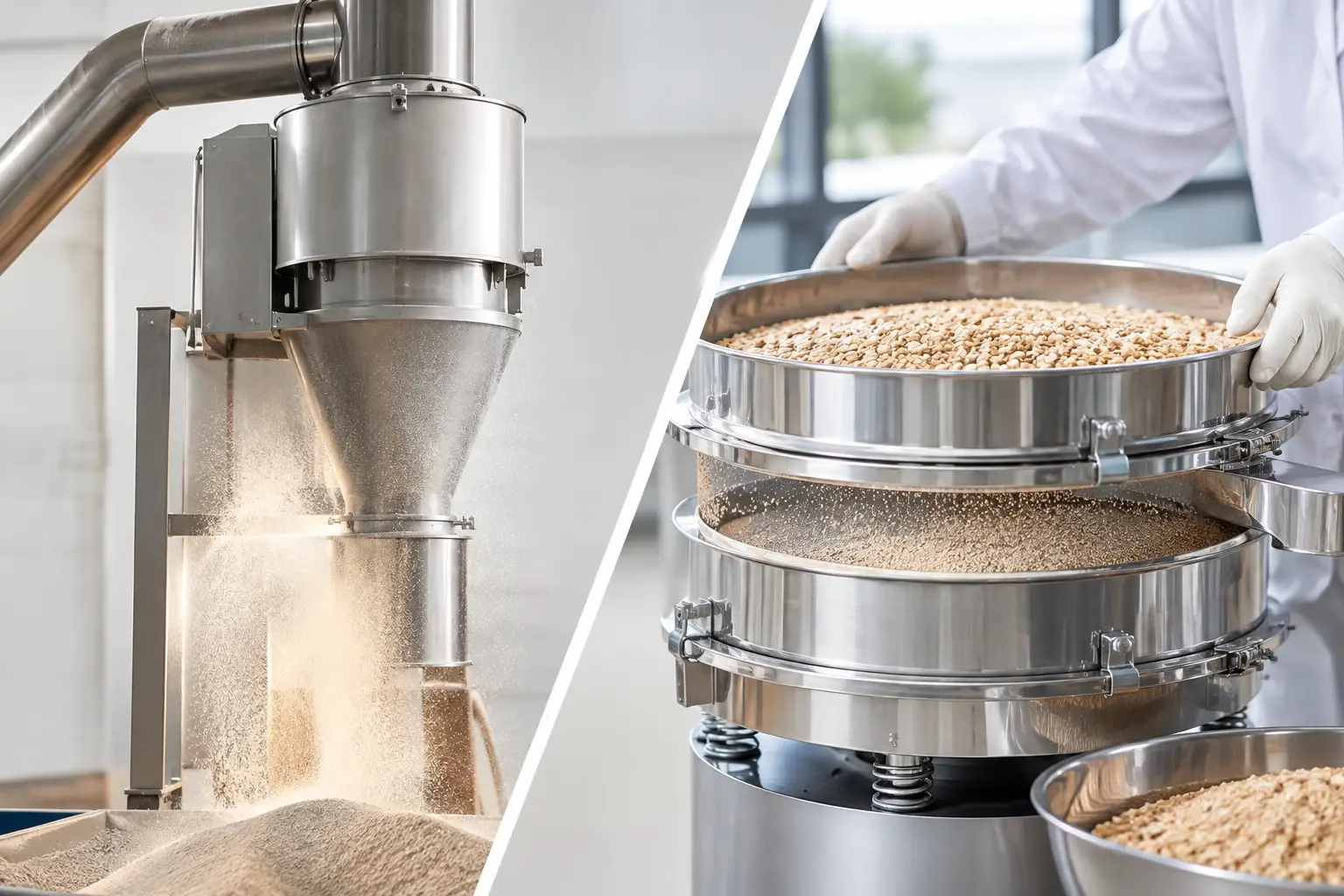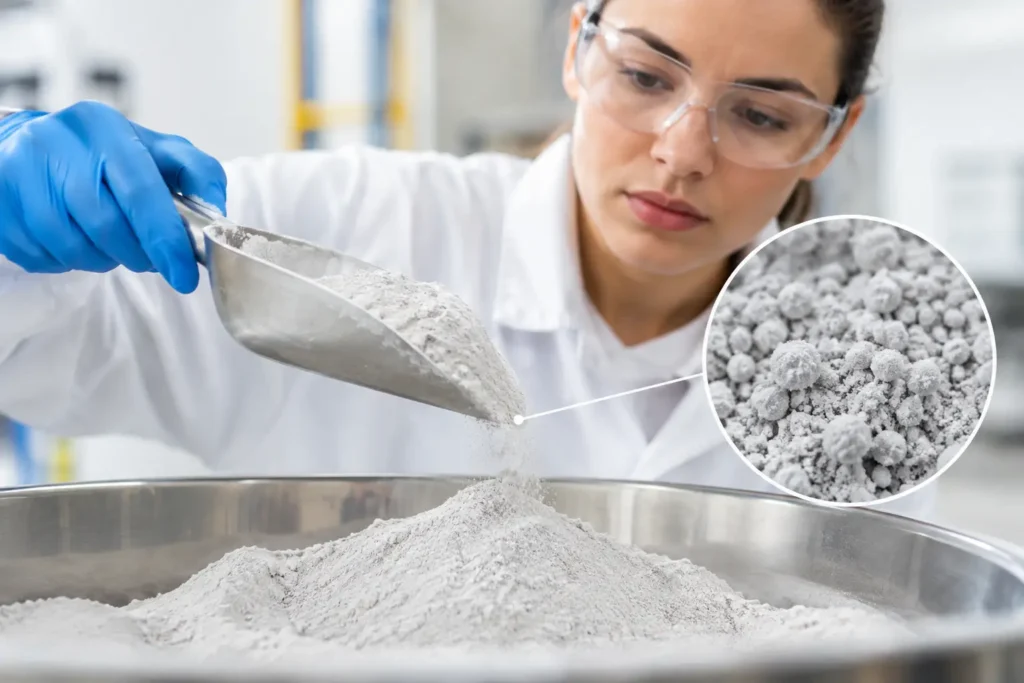
A powder that flows consistently in a pilot run can bridge in a hopper, form lumps during storage, or create unacceptable variability at full production scale. Knowing how to control particle agglomeration is therefore not a single equipment decision. It is a process-engineering task that begins with the material and extends across receiving, storage, transfer, conditioning, size reduction, blending, and packaging.
Agglomeration is not always a defect. In some applications, controlled granulation improves flow, reduces dust, supports tablet compression, or produces a preferred dissolution profile. The objective is to distinguish desirable, engineered agglomerates from uncontrolled particle bonding that disrupts throughput, uniformity, cleanability, and finished-product performance.
Why Particle Agglomeration Develops
Particles agglomerate when attractive forces overcome the forces separating them. The dominant mechanism depends on the product chemistry, particle-size distribution, operating environment, and process history. Fine particles are especially susceptible because their surface area is high relative to their mass. As particles become smaller, van der Waals forces, electrostatic attraction, and liquid bridging can have an outsized effect on bulk behavior.
Moisture is one of the most common causes. Hygroscopic powders can absorb water from ambient air, creating capillary bridges between particles. Even modest moisture pickup may be enough to change flowability, particularly when fine fractions are present. Temperature variation compounds the problem: warm product entering a cooler room can create localized condensation, while storage near external walls or unconditioned loading areas can produce changing humidity exposure.
Other materials agglomerate because of fat migration, partial melting, solvent residues, binder content, pressure consolidation, or chemical reaction. A cohesive product may compact during long residence times in bins, intermediate bulk containers, or packages. Pneumatic conveying can also contribute through heat generation, attrition, velocity-driven segregation, and electrostatic charge. The same powder may behave acceptably in one transfer route and poorly in another.
Start With Material Characterization, Not Equipment
Controlling agglomeration starts with identifying the specific mechanism at work. Treating every lumping issue as a milling problem often adds cost and particle damage without correcting the root cause.
A useful characterization program evaluates particle-size distribution, particle shape, moisture content, water activity where relevant, bulk and tapped density, flow function, compressibility, angle of repose, and temperature sensitivity. For specialty materials, surface chemistry, electrostatic behavior, fat content, solvent levels, and crystallinity may also be decisive. Samples should be taken from multiple points, including incoming material, post-process material, and material that has experienced storage or transfer.
The time dimension matters. A powder may pass a sieve immediately after production yet form stable lumps after 24 hours in a tote. Likewise, material tested at room conditions may not represent its behavior in a humid summer receiving area or a warm process room. Process engineers should evaluate the product under realistic temperature, humidity, pressure, and residence-time conditions.
Define What “Control” Means for the Product
The acceptable endpoint varies by application. A food powder may require free flow and rapid reconstitution. A pharmaceutical blend may require tight content uniformity with minimal particle attrition. Battery and additive-manufacturing powders may need carefully preserved morphology and a narrowly controlled particle-size distribution. Industrial minerals may tolerate some agglomerates but require reliable feeder performance.
Define measurable limits before selecting a solution. These can include maximum oversize content, screen retention, flow-function range, moisture limit, feeder mass-flow stability, blend uniformity, dissolution time, or allowable density variation. Clear acceptance criteria align operations, quality, engineering, and equipment suppliers around the same outcome.
Control Humidity, Temperature, and Storage Conditions
Environmental control is frequently the highest-value intervention because it prevents the bonds that create agglomerates rather than breaking them apart later. The required setpoints depend on the material. A low-moisture hygroscopic powder may need dry-air handling from receiving through packaging, while another product may be stable if temperature swings and condensation are eliminated.
Control should extend beyond the process room. Incoming packaging, pallet staging, bulk-bag unloading, intermediate storage, and transfer connections can all expose product to uncontrolled air. Open charging points and long-held surge hoppers are common weak points. If a powder enters a dry process line after sitting in a humid warehouse, downstream equipment cannot fully reverse the change in material condition.
Storage geometry also affects agglomeration. Tall vessels can impose enough static head pressure to compact cohesive powders. Long residence times increase the opportunity for moisture migration and consolidation. Mass-flow hopper design, appropriate wall angles, low-friction liners, controlled discharge, and first-in, first-out inventory practices reduce the likelihood of stagnant zones and compacted material.
Use Mechanical Energy Carefully
When agglomerates are already present, size reduction, screening, de-lumping, and classification can restore a usable particle distribution. The right method depends on the material’s friability and the nature of the agglomerate.
A low-speed de-lumper may be sufficient for soft, moisture-related lumps formed during handling. It can protect the desired primary particle size while removing oversize material before feeding, blending, or packaging. For stronger agglomerates, an appropriately selected mill may be required. Rotor speed, screen size, air flow, feed rate, and dwell time must be matched to the product, because excessive energy can create fines, generate heat, alter morphology, or damage sensitive ingredients.
Screening is valuable when the goal is to remove occasional oversize particles without changing the main population. However, screens should not become a substitute for process control. Frequent blinding, high reject rates, or repeated recirculation usually indicate an upstream moisture, storage, or transfer issue that needs correction.
Engineer the Transfer and Feeding System as One System
Particle agglomeration is often diagnosed at the feeder because that is where it becomes visible. The actual cause may be farther upstream. A poorly designed transfer path can create compaction, segregation, buildup, and temperature changes before the material reaches the dosing point.
For cohesive materials, minimize unnecessary drops, dead zones, abrupt direction changes, and extended horizontal runs. Select pneumatic conveying conditions that balance transport reliability against attrition and heat. Dense-phase conveying may reduce particle impact for some products, but it is not universally suitable. Dilute-phase systems may be appropriate where line cleaning, distance, or throughput requirements govern, provided velocities and air conditions are controlled.
Feeding equipment must account for the product’s real flow behavior, not its idealized specification. Agitators, live bottoms, screw configurations, hopper inserts, and refill strategy should be designed to prevent ratholing, bridging, and density variation. A feeder that receives nonuniform material cannot consistently deliver a uniform mass flow, regardless of its control accuracy.
Avoid Solving Cohesion With More Agitation Alone
Mechanical agitation can maintain flow, but too much agitation may compact some powders, generate fines, or separate blends by particle size and density. The appropriate solution may be gentle conditioning, a different hopper design, reduced refill height, or environmental control rather than a larger or faster agitator.
This is where integrated trials are essential. Testing a feeder independently can miss interactions among the hopper, transfer line, conditioning device, and downstream process. Production performance should be validated at intended throughput and with realistic run duration, not only during short demonstration runs.
Build Monitoring Into the Control Strategy
A stable process requires measurement at the conditions that influence agglomeration. Moisture and temperature monitoring at receiving, process air handling, and critical transfer points can reveal trends before product quality is affected. Load cells, feeder torque, motor current, pressure differential, and pneumatic conveying data can identify developing buildup or changes in flow behavior.
The most useful controls connect material condition to operating response. For example, a system may hold or divert a lot that exceeds a moisture threshold, adjust dry-air supply based on dew point, alarm on abnormal feeder torque, or require screening before a sensitive downstream operation. Automation should support disciplined decisions, not simply collect data.
For regulated or high-value products, the control strategy should include defined sampling plans, documented setpoints, alarm response procedures, cleaning verification, and change-control requirements. A modification to packaging, an ingredient supplier, a dryer profile, or a warehouse environment can change agglomeration risk even when the core formulation remains unchanged.
Treat Agglomeration as a Whole-Line Performance Issue
The best answer to how to control particle agglomeration is rarely a stand-alone mill, sieve, or feeder. It is a coordinated design that keeps material within its acceptable moisture, temperature, particle-size, and stress limits from receipt to final pack.
Proc-X approaches these challenges from the material outward: characterize the product, establish the process objective, and engineer compatible handling, conditioning, milling, feeding, and control functions around it. That approach reduces isolated fixes and creates a line that performs predictably as capacity, formulations, and operating demands change.
When agglomeration becomes visible, the most productive next step is to trace the material’s complete history rather than focus only on the point of failure. The evidence usually shows whether the product needs prevention, gentle conditioning, controlled size reduction, or a more fundamental change in how the process handles it.