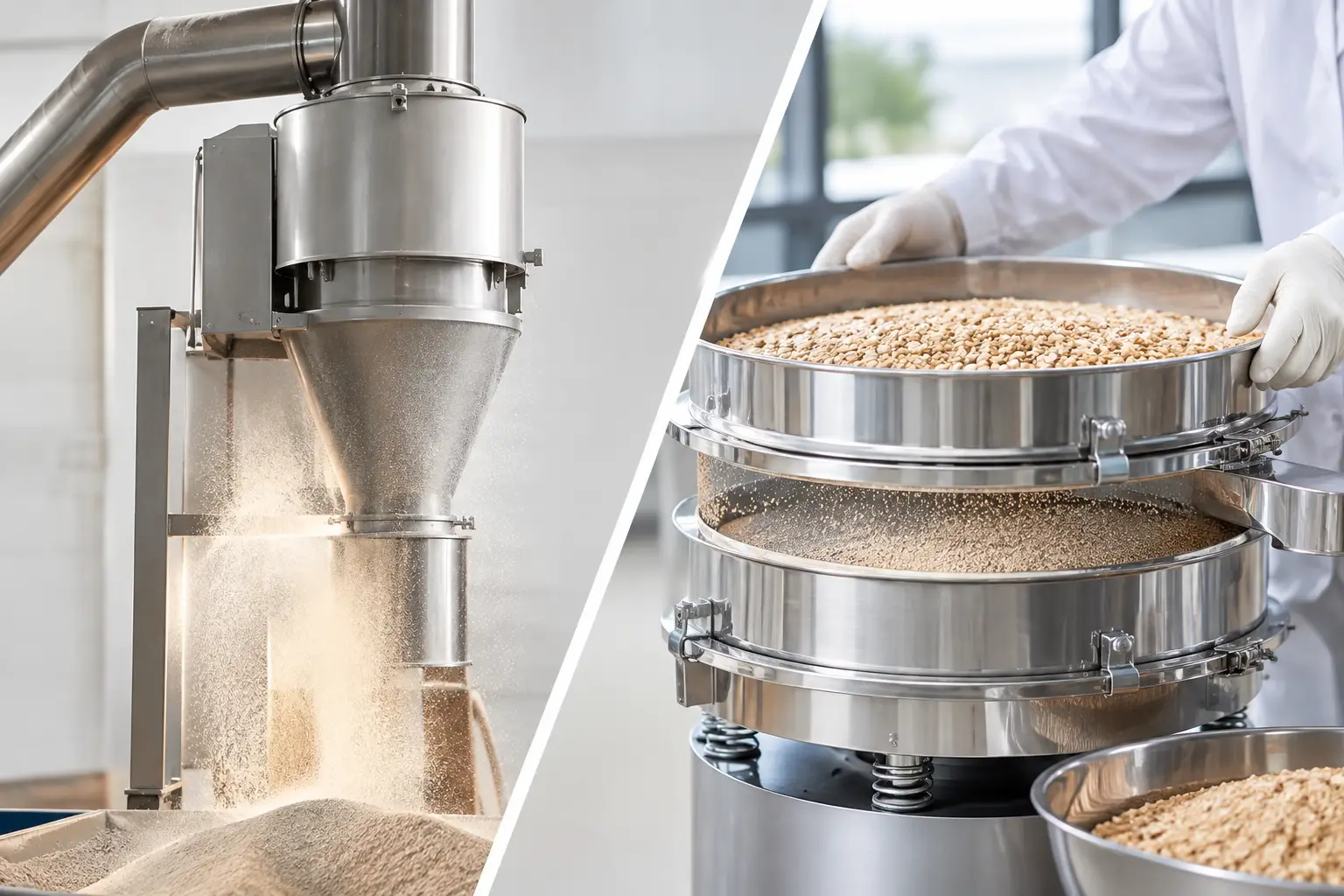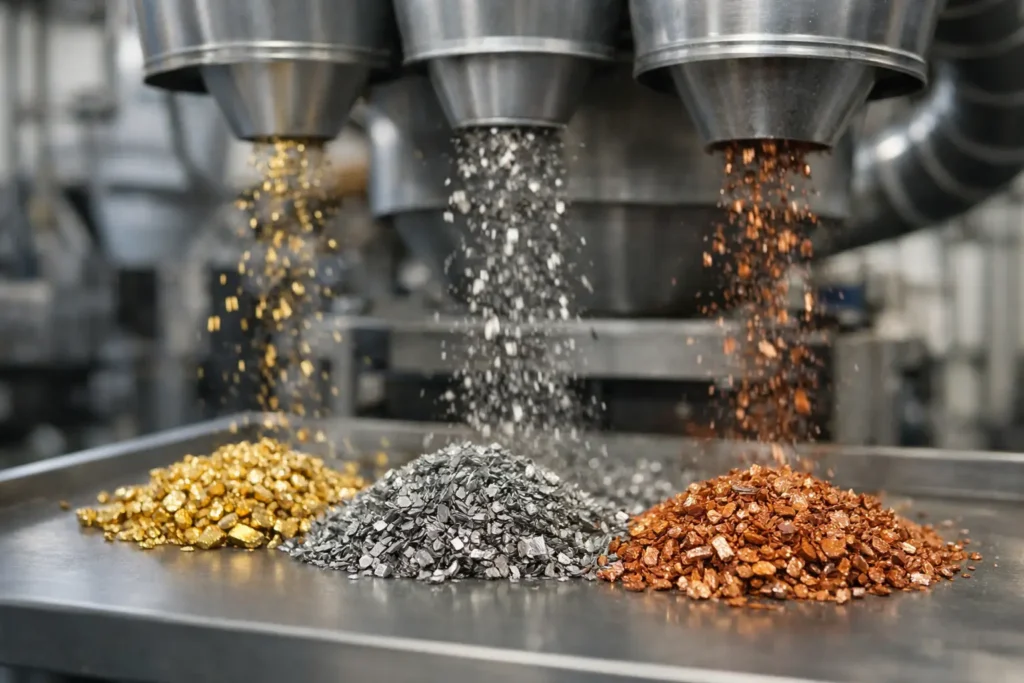
When valuable metal is leaving the line in the fines stream, separation stops being a secondary operation and becomes a margin issue. Precious metal separation using air classifiers is often considered when processors need tighter control over particle cut points, lower contamination risk, and better recovery performance without relying solely on wet methods.
Where air classification fits in precious metal recovery
Air classification is a dry separation method that sorts particles by aerodynamic behavior rather than chemistry. In practical terms, it separates lighter or finer material from heavier or coarser fractions by controlling airflow, rotor speed, feed rate, and internal geometry. For precious metal applications, that matters because gold, silver, platinum group metals, and metal-bearing compounds rarely arrive in a clean, uniform feed.
Instead, processors are dealing with milled ore concentrates, catalyst residues, electronic scrap derivatives, polishing waste, battery-related materials, or specialty powders. These streams often contain a wide particle size distribution, mixed densities, and fines that are difficult to manage with screens alone. Air classifiers create a more defined split, which can improve the efficiency of downstream concentration, thermal processing, or refining.
This is not a universal replacement for gravity tables, flotation, magnetic separation, or hydrometallurgical recovery. It is a process step that can improve the economics and stability of the full system when the material profile supports it.
How precious metal separation using air classifiers works
The basic principle is straightforward. A feed enters the classifier in a controlled air stream. As particles move through the classification zone, finer or lower-mass particles are carried with the air, while coarser or denser particles resist the flow and report to the coarse fraction. Adjustable operating parameters determine the cut point.
In precious metal recovery, the value comes from selective preparation rather than direct final purification. If precious metal values are preferentially associated with a particular particle size range, air classification can isolate that fraction before additional processing. That reduces the volume going to high-cost downstream recovery stages and can improve the consistency of the feed entering them.
This distinction matters. Air classifiers separate based on particle behavior in air, not intrinsic metal content alone. If the precious metal is locked uniformly across all particle sizes, classification may offer limited benefit. If the metal is enriched in fines, liberated at a certain grind, or attached to denser particulates that present different aerodynamic behavior, the technology becomes more compelling.
Feed characteristics drive performance
The success of an air classifier starts with the feed. Moisture content, particle shape, agglomeration tendency, bulk density, and top-size distribution all affect the quality of separation. Fine precious metal powders and metal-bearing dusts can be cohesive, which reduces classification efficiency and increases the risk of buildup.
That is why the classifier cannot be evaluated in isolation. Upstream size reduction, drying, deagglomeration, and feed metering are part of the same engineering problem. A well-designed system stabilizes the material before it reaches the classification zone. A poorly prepared feed can make even a high-quality classifier underperform.
When air classifiers make sense
The strongest case for precious metal separation using air classifiers is when dry processing is preferred and the target material shows a meaningful difference in aerodynamic response after milling or liberation. This is common in specialty recycling and advanced materials environments where water use, slurry handling, or reagent management create added complexity.
Electronic scrap is one example. After shredding and milling, the resulting fraction can include metals, plastics, fiberglass, and mineral residues. Air classification can help split lighter non-metallic fractions from heavier concentrates, improving the feed quality to downstream recovery equipment. The same logic applies to catalyst recovery, where carrier material and metal-bearing fines may behave differently under controlled airflow.
It can also be useful in powder reclamation and process scrap recovery when the objective is to remove oversized contamination, isolate a reusable fine fraction, or tighten distribution before thermal or chemical treatment. In these cases, the classifier supports yield, but it also supports process consistency. That is often just as valuable in a production setting.
The main engineering advantages
One advantage is dry operation. Eliminating water from the separation stage reduces wastewater handling, drying demand, and the complications that come with moisture-sensitive materials. In regulated environments, that can simplify both operations and plant infrastructure.
Another advantage is cut-point control. Modern air classifiers allow operators to tune performance within a relatively narrow range, which helps create more consistent fractions than basic mechanical screening in fine particle applications. That consistency supports better downstream process control, whether the next step is blending, thermal treatment, chemical leaching, or packaging.
Air classifiers also integrate well into continuous systems. For manufacturers and processors operating at production scale, this is a significant benefit. A classifier can be paired with mills, feeders, dust collection, pneumatic transfer, and automation under one coordinated controls strategy. That lowers manual handling, improves containment, and reduces opportunities for material loss.
The limits and trade-offs
Air classification is not a shortcut to high recovery. It has limits that need to be addressed at the design stage.
First, separation efficiency declines when particles are too similar in aerodynamic behavior. If two fractions have overlapping size, density, and shape characteristics, the split will be less sharp. Second, sticky or humid materials can foul internal surfaces and distort airflow patterns. Third, very abrasive feeds can increase wear, which affects both maintenance intervals and long-term cut-point stability.
There is also a trade-off between throughput and precision. Running more material through the classifier may reduce the sharpness of separation, especially with difficult feeds. Operations teams need to decide whether the priority is maximum tonnage, tighter recovery, or a balanced operating window.
This is why pilot testing matters. Bench assumptions are useful, but they do not replace material trials under controlled conditions. For precious metal streams, small changes in recovery efficiency can have large financial consequences. The system should be sized and configured around actual performance data, not nominal equipment ratings.
System integration matters more than the classifier alone
In high-value material recovery, the equipment list is not the process strategy. The classifier has to work as part of a broader engineered line.
A stable solution typically includes controlled feed presentation, proper size reduction ahead of classification, air handling sized for the material load, dust collection designed for fine particulate containment, and downstream routing that preserves the value of each separated fraction. Controls integration is equally important. Operators need visibility into airflow, pressure, rotor settings, feed consistency, and collection performance to maintain repeatable results.
This is where a single-source engineering approach has practical value. When one partner is responsible for the upstream and downstream interfaces, the classifier is not forced to compensate for inconsistent feed conditions or poor transfer design. Proc-X approaches these challenges as complete process systems, which is the right model for applications where yield, containment, and uptime are closely linked.
Safety and containment cannot be treated as add-ons
Many precious metal-bearing powders create dust management concerns. Some are combustible. Others are hazardous, toxic, or simply too valuable to lose into housekeeping streams. Air classification systems need proper enclosure, filtration, pressure management, and maintenance access designed around the specific material risk profile.
That includes more than compliance. Good containment protects recovery rates, equipment reliability, and operator safety at the same time. If fines are escaping at transfer points or building up in the wrong parts of the system, the process is already underperforming.
What to evaluate before selecting a system
The right question is not whether an air classifier can separate a material. The right question is whether it can create a commercially meaningful improvement in the full recovery process.
That means looking at the metal distribution by particle size, required throughput, allowable fines loss, desired product specification, moisture limits, and maintenance expectations. It also means understanding what happens after classification. A clean split only has value if the downstream process can capitalize on it.
For some operations, a static system with basic adjustment may be adequate. For others, especially where feed variability is high, dynamic classification with tighter controls and automated feedback will justify the investment. The answer depends on feed behavior, production targets, and the cost of misclassification.
Precious metal recovery rewards precision, but it also rewards disciplined system design. Air classification can be a highly effective step when it is applied for the right reason, tested against real material behavior, and integrated into a line engineered for accountability from end to end. That is usually where the biggest performance gains are found – not in a standalone machine, but in a process system built to control the entire separation environment.