A mixer can meet its rated throughput and still fail the production requirement. The usual cause is not a lack of motor power. It is a mismatch between the mixing mechanism, the material’s behavior, and the conditions surrounding the machine. Industrial mixers must be specified around the product and the process, not selected as stand-alone vessels with an agitator attached.
For a plant manager or project engineer, the practical question is not simply, “What mixer do we need?” It is: “What level of uniformity, batch repeatability, throughput, cleanability, and downstream performance must this operation deliver?” The answer determines the mixer type, drive arrangement, controls, material of construction, discharge design, and the equipment that feeds and receives it.
Start With the Material, Not the Mixer
Material properties define the real duty. Powders that appear similar in a sample container can respond very differently in production. Differences in bulk density, particle-size distribution, moisture level, electrostatic charge, oil content, friability, and flowability affect how ingredients move through the mixer and whether they separate after blending.
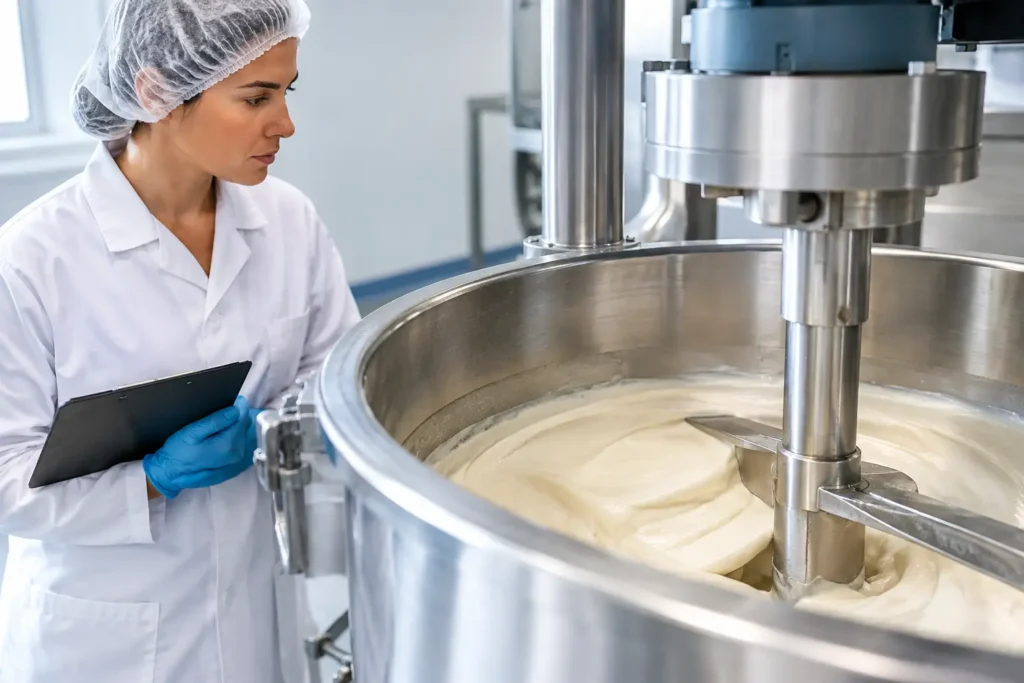
A free-flowing dry blend may require gentle convective mixing to protect particles and preserve a narrow particle-size distribution. A cohesive powder may need higher-intensity action, choppers, lump reduction, or a controlled liquid addition step. A high-viscosity paste may require a completely different machine architecture, including close-clearance tools, high-torque drives, jacketed vessels, vacuum capability, and a discharge system designed for material that will not flow by gravity.
The same principle applies to liquid and slurry processes. Viscosity, density differences, solids loading, shear sensitivity, gas entrainment, and heat transfer requirements all influence impeller selection and vessel geometry. A mixer that disperses a powder into liquid effectively may not be suitable for emulsification. A unit designed for emulsification may introduce more shear or heat than a fragile formulation can tolerate.
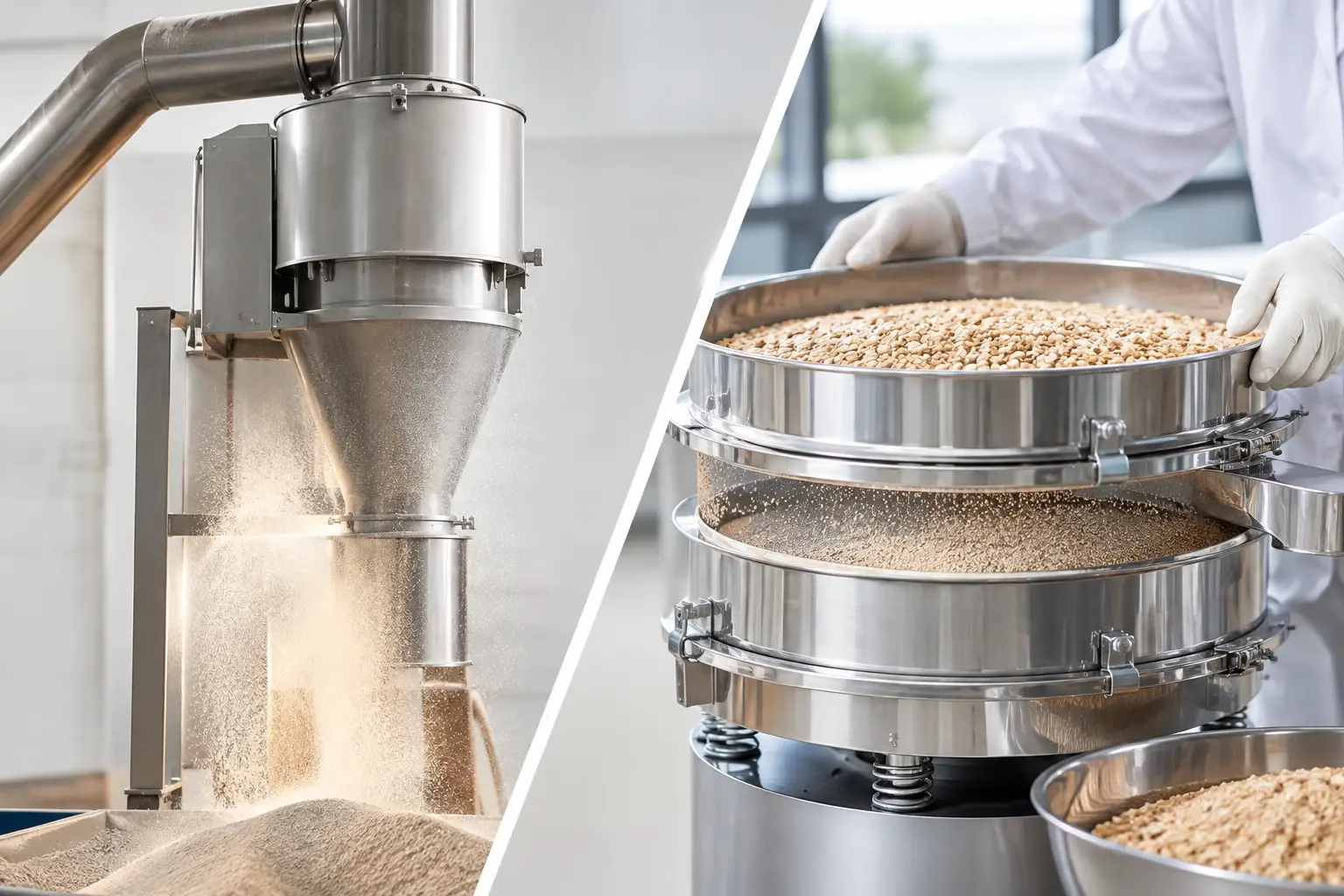
Process teams should also consider what happens before and after mixing. An incoming powder may bridge in a hopper, deliver inconsistent feed rates, or contain agglomerates that compromise blend quality. A finished blend may segregate during pneumatic transfer, bin storage, filling, or packaging. The mixer cannot compensate indefinitely for uncontrolled upstream feeding or a downstream transfer method that reverses the uniformity achieved in the batch.
What Industrial Mixers Are Expected to Deliver
Mixing is often described as a single operation, but production objectives vary considerably. Blending combines ingredients to achieve distribution uniformity. Dispersion breaks apart agglomerates and distributes solids in a liquid. Homogenization reduces variation in a liquid or semi-solid system. Emulsification creates and stabilizes a mixture of immiscible phases. Kneading develops or conditions high-viscosity materials through intensive mechanical work.
Those objectives require different energy inputs and material movement. A low-shear ribbon or paddle mixer may be appropriate for dry food ingredients, premixes, mineral blends, and granular products where particle integrity matters. A plow mixer can provide more intensive mechanical action and can support liquid addition or deagglomeration with high-speed choppers. Conical screw, double-cone, and V-style configurations may suit specific free-flowing powders, particularly where gentle handling and complete discharge are priorities.
For liquids, agitator systems may use axial-flow, radial-flow, or high-shear impellers based on the required circulation, dispersion, or emulsification result. Planetary, sigma blade, and other heavy-duty configurations address pastes, doughs, adhesives, battery materials, polymers, and similar high-viscosity applications. Vacuum-rated systems can remove entrained air, manage volatile components, or support controlled thermal processing.
There is no universal “best” design. Higher intensity can reduce mixing time and break agglomerates, but it can also generate heat, degrade friable particles, alter crystal structure, or create cleaning challenges. Gentle mixing can protect the product, but may not overcome density-driven separation or distribute low-dose ingredients reliably. The correct choice follows the formulation and the quality target.
Define Uniformity in Measurable Terms
A specification that calls for “uniform blending” is incomplete. The process team must establish how uniformity will be measured, which component is critical, where samples will be taken, and what acceptance limits apply. In many formulations, the most demanding component is not the major ingredient. It is the low-inclusion active, colorant, flavor, micronutrient, lubricant, or additive that must be distributed at a very small percentage.
Sampling plans matter because powder mixtures are not perfectly static. A representative sample from one location does not prove batch-wide uniformity. Product testing should reflect the actual discharge pattern, the intended batch size, the normal operating fill level, and the effect of subsequent handling. Development trials should test not only the blend at the mixer outlet, but also material after transfer and before final filling when segregation is a risk.
Batch time should be established through trials rather than assumed from nameplate capacity. Mixing too briefly leaves concentration variation. Mixing too long can cause attrition, heat buildup, phase separation, or further segregation in some dry materials. A validated operating window is more useful than a single theoretical mixing time.
Mixer Design Is Also a System Design Decision
The mixer is one part of a material-processing line. Its performance depends on how accurately ingredients are weighed, how consistently they are fed, how liquids are introduced, and how the finished product is discharged and conveyed. A well-designed system maintains control at each handoff.
For example, manual addition of minor ingredients may be workable at small scale, but it introduces operator dependency and traceability limitations as batch frequency rises. Automated weighing, recipe control, barcode verification, and loss-in-weight feeding can improve repeatability where formulation accuracy is critical. Liquid addition systems need appropriate metering, spray coverage, temperature control, and cleaning provisions. Pouring liquid into a single point of a powder bed can form wet balls rather than distribute the binder evenly.
Discharge deserves the same attention as mixing. The outlet must empty reliably, protect the product, and interface with the next operation without creating residual material or uncontrolled exposure. Depending on the material, this may require a full-width discharge, a conditioned valve, an intermediate hopper, vacuum transfer, mechanical conveying, or direct connection to filling and packaging equipment.
Controls should support the actual operating strategy. Useful functions may include recipe management, ingredient confirmation, timed or torque-based mixing, temperature monitoring, vacuum control, speed control, batch reporting, alarm history, and plant-level data exchange. Automation is not valuable because it adds screens. It is valuable when it prevents wrong-material additions, holds critical parameters within range, and creates a usable production record.
Sanitation, Containment, and Maintenance Must Be Designed In
Food, pharmaceutical, nutraceutical, cosmetic, chemical, and advanced-material applications each introduce different requirements for cleanability, containment, and verification. Product-contact finishes, gasket design, shaft seals, access doors, drainability, clean-in-place capability, and changeover procedures should be evaluated before equipment is released for manufacture.
A mixer with difficult internal geometry may perform well mechanically but create excessive downtime between products. Conversely, a highly sanitary configuration may carry a higher capital cost and require more disciplined utility and validation planning. The right balance depends on product risk, campaign length, allergen or potent-material controls, cleaning validation requirements, and the cost of lost production time.
Containment is equally application-specific. Fine powders, hazardous chemicals, active pharmaceutical ingredients, and battery materials may require enclosed charging, dust collection, controlled discharge, and integration with air-control systems. Where combustible dust is present, the design must account for the identified hazard, facility classification, venting or isolation strategy, grounding, and operating procedures. These are plant-level decisions, not accessories added after the mixer is installed.
Maintenance access affects lifecycle performance. Drives, seals, bearings, choppers, and discharge components should be selected for the actual duty cycle and inspected without turning routine service into a major shutdown. Abrasive minerals and ceramics may demand wear-resistant contact surfaces. Sticky products may require features that limit buildup. High-torque applications require a drivetrain with appropriate service factors, not just sufficient nominal horsepower.
Build Confidence Through Product Trials and Engineering Review
For a new formulation, difficult scale-up, or high-value product, testing is the most direct way to reduce equipment risk. Trials should use representative materials whenever possible and evaluate the conditions that production will actually face: minimum and maximum batch sizes, normal ingredient addition order, liquid dosing rates, temperature limits, mixing time, discharge behavior, and cleaning method.
The engineering review should extend beyond the mixer. It should confirm structural support, utilities, control philosophy, operator access, dust handling, upstream and downstream interfaces, installation constraints, and future capacity needs. A machine that fits the process but cannot fit the building, integrate with existing controls, or support expansion is not a complete solution.
Proc-X approaches industrial mixing as part of an integrated processing responsibility: one engineered standard across material handling, dosing, mixing, transfer, controls, and downstream operations. That perspective reduces the gaps that commonly appear when separate suppliers optimize individual machines without ownership of the full process outcome.
The right mixer is the one that produces a repeatable product under normal operating conditions, not the one with the most aggressive specification sheet. Start with the material, define the measurable quality requirement, and engineer every connection around the mixer with the same level of discipline.