A guide to hygienic process system design starts where many capital projects go wrong: with the product and contamination risks, not with a preferred machine or a polished equipment layout. A processing line can meet its target throughput and still create unacceptable exposure to microbiological growth, allergen carryover, foreign material, cleaning chemicals, or operator error. Hygienic performance must be designed into the complete production path, from receiving and storage through processing, transfer, filling, and cleaning.
For food, beverage, pharmaceutical, nutraceutical, cosmetic, and other controlled manufacturing environments, hygiene is not a finish applied to equipment after selection. It is an operating capability. The system must support repeatable cleaning, controlled access, drainage, inspection, verification, and recovery after normal production events. That requires engineering decisions that account for material behavior, process conditions, plant utilities, automation, and the way the line will actually be maintained.
Hygienic Design Is a System Property
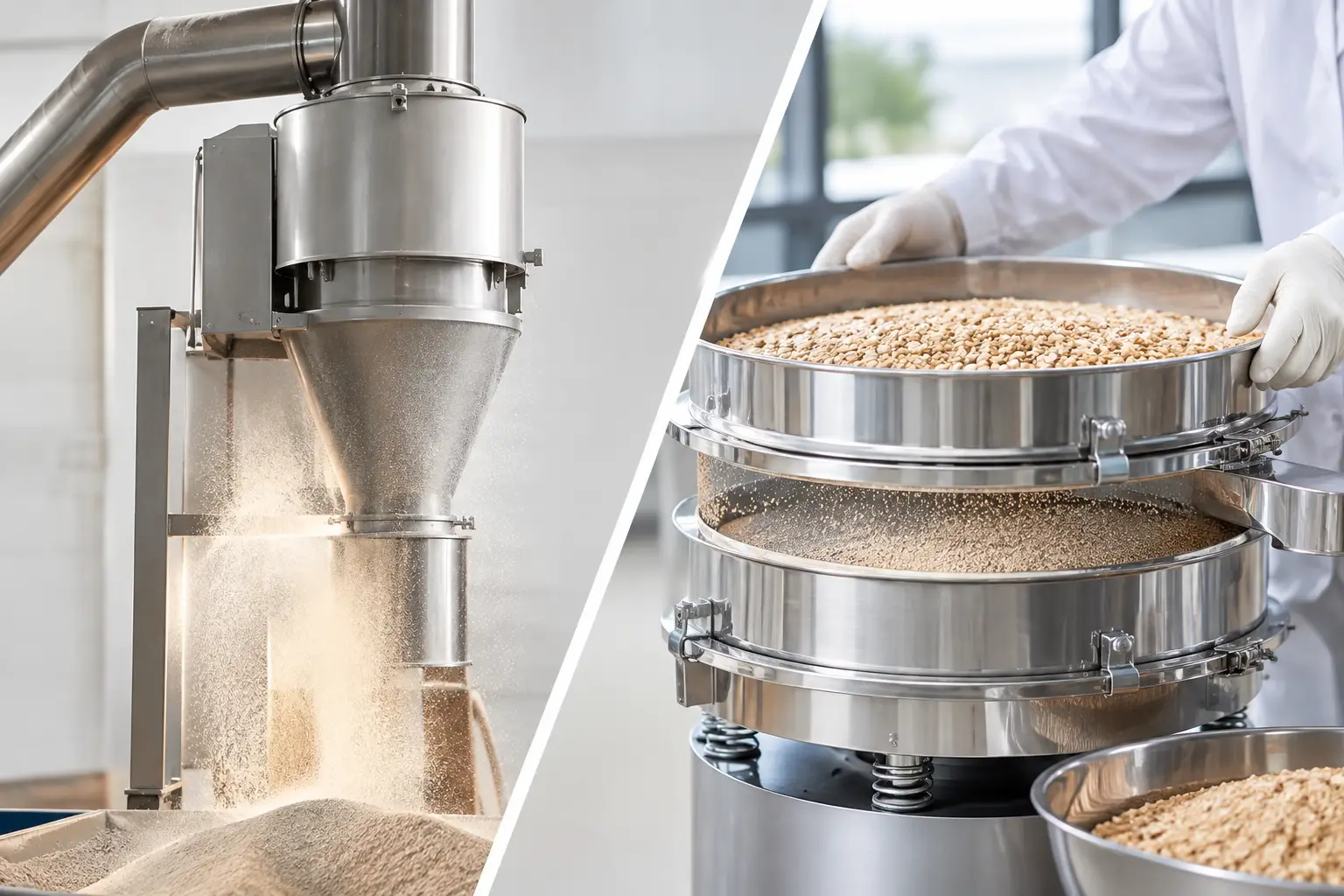
A hygienic vessel does not make a hygienic line. Product can be protected inside a well-designed mixer and then compromised by a poorly routed transfer line, an inaccessible valve manifold, an uncleanable filter housing, or a dusty packaging interface. The same principle applies to dry processing. While dry powders may not face the same microbial risks as wet products, they can create serious cross-contact, residue accumulation, pest-control, moisture-ingress, and dust-containment concerns.
The required level of hygienic design depends on the product, hazard analysis, regulatory framework, cleaning strategy, and production schedule. A ready-to-eat food process, aseptic pharmaceutical operation, and dry mineral blending system require different controls. Treating them as identical raises cost without necessarily improving risk control. Treating them as ordinary industrial systems can leave critical exposure points unaddressed.
The engineering objective is clear: establish a defined product boundary, eliminate or control contamination paths, and make every product-contact area accessible for cleaning or reliably cleanable in place. Just as important, the system must prove that those conditions are maintained during operation.
Define the Product and Operating Risks Before Layout
Before equipment is specified, the project team should document how the material behaves and what can make the finished product unacceptable. This includes microbiological sensitivity, allergen status, potency, moisture uptake, particle segregation, batch-to-batch carryover limits, cleaning-agent compatibility, and allowable foreign-material risk. Process conditions matter equally. Temperature, viscosity, fat or sugar content, solvent use, shear sensitivity, hold time, and pressure all affect the hygienic design approach.
A product that hardens during shutdown, for example, may require short transfer paths, heated components, flush capability, and rapid disassembly. A cohesive nutraceutical powder may adhere to flexible connectors, valve seats, and low-velocity zones. A high-care food powder may need controlled air handling and carefully separated personnel and material flows. These are process decisions with hygienic consequences.
Production planning also changes the answer. A single-product line operated continuously may support a different cleaning architecture than a multi-product line with frequent allergen changeovers. Higher levels of automation can reduce manual intervention and improve cleaning repeatability, but they add valves, instrumentation, and control logic that must themselves be hygienically engineered and maintained.
Design Cleanability Into Equipment Selection
Equipment should be evaluated by how it can be cleaned, inspected, drained, and returned to service, not only by its processing duty. Product-contact surfaces need appropriate material selection, surface finish, weld quality, geometry, and compatibility with the product and cleaning media. Crevices, threads, ledges, dead legs, damaged elastomers, and poorly supported flexible connections can retain product long after normal cleaning activity appears complete.
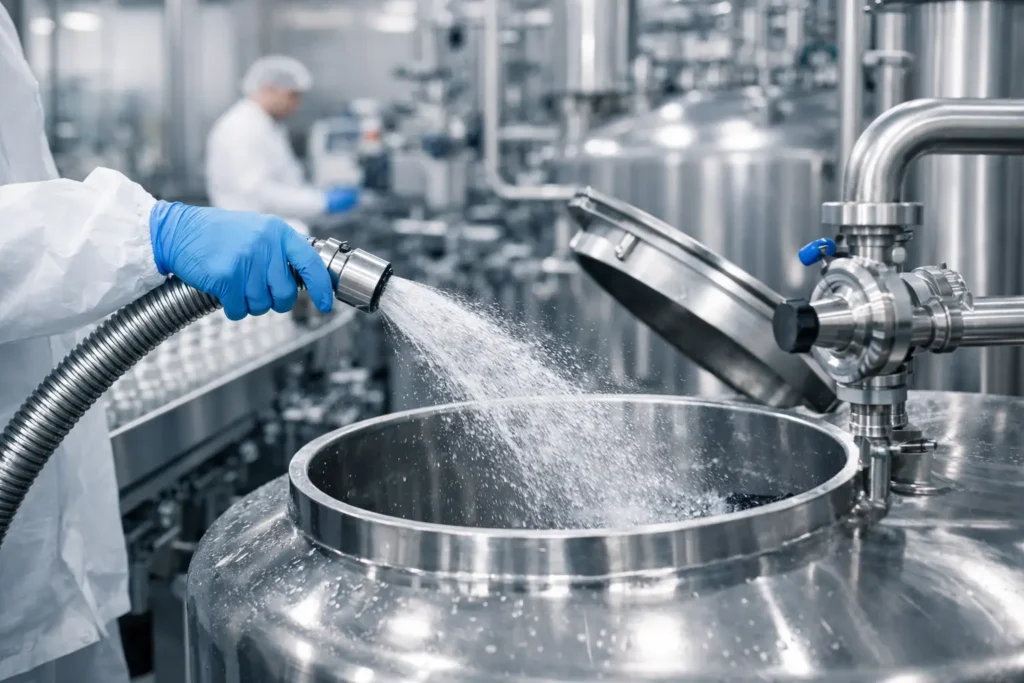
For wet and viscous applications, clean-in-place capability often depends on more than spray devices inside a vessel. The cleaning circuit must achieve adequate coverage, flow velocity, temperature, concentration, and contact time at the hardest-to-clean locations. Lines need to drain effectively, and valves must be configured so all wetted cavities are addressed. A cleaning sequence that works in a water test may fail when the equipment contains a sticky emulsion, protein film, high-solids slurry, or heat-affected residue.
For dry handling, the design may rely on dry cleaning, vacuum recovery, controlled disassembly, or limited wet cleaning. Each choice has trade-offs. Wet cleaning can provide a high level of residue removal but may introduce drying time, corrosion risk, microbial risk, and schedule impact. Dry cleaning avoids water introduction but demands excellent access, containment, dust collection, and procedural discipline. The right solution follows the material, not a standard preference.
Drainage, Access, and Product Hold-Up
Gravity is a hygienic design tool. Vessels, piping, chutes, and transfer components should be arranged to prevent stagnant product or cleaning solution from remaining in the system. Complete drainage is especially significant where standing water can support microbial growth or where cleaning chemicals must be fully removed before production.
Access must be realistic for the maintenance team. A removable cover that requires lifting equipment, extensive guard removal, or several hours of downtime may be technically accessible but operationally neglected. Design reviews should consider gasket replacement, inspection of internal surfaces, sensor removal, filter changes, and clearing of foreseeable blockages. A line that cannot be serviced efficiently will eventually be serviced inconsistently.
Control Contamination at System Interfaces
The highest-risk points are often where systems connect. Raw-material discharge stations, bag dump areas, bulk bag unloaders, pneumatic conveying receivers, intermediate bulk containers, manual additions, sampling stations, and packaging machines all cross a product or environmental boundary. These interfaces require containment and cleanability at the same level as the primary process equipment.
Air management deserves close attention. Air can move powders, aerosols, moisture, and environmental contaminants between rooms and equipment. Dust-collection pickup points, enclosure leakage, pressure relationships, and return-air strategy should be coordinated with the hygienic zoning plan. A local dust collector may improve housekeeping while creating a cross-contamination path if its air handling and discharge arrangements are not properly evaluated.
Personnel and maintenance access must also fit the layout. Where high-care areas are required, the system should minimize unnecessary entry and support controlled movement of tools, components, and waste. Separating raw and finished-product flows can be more effective than adding cleaning steps after the fact.
Engineer Cleaning as a Repeatable Process
Cleaning is a process with inputs, parameters, outputs, and acceptance criteria. It should be engineered with the same discipline applied to mixing, dosing, milling, or thermal treatment. The system needs defined cleaning recipes, utility capacity, chemical delivery, return paths, temperature control, and, where appropriate, automated sequencing.
A reliable clean-in-place design addresses the entire circuit: supply tank, pumps, heat source, chemical concentration control, distribution piping, spray devices, process equipment, return line, and recovery or disposal. Undersized utilities or poorly balanced circuits can make cleaning inconsistent across parallel equipment. Conversely, a highly automated cleaning skid may be unnecessary for a small, low-frequency operation where validated manual cleaning is practical and sustainable.
Verification should match the hazard. Visual inspection may be sufficient for certain non-product-contact exterior areas, while allergen-sensitive, pharmaceutical, or microbiologically controlled processes can require swab testing, rinse analysis, conductivity monitoring, temperature records, or other documented evidence. The goal is not to collect data for its own sake. It is to demonstrate that the defined cleaning method controls the identified risk.
Build Controls, Validation, and Maintenance Into the Design
Hygienic performance declines when process settings, cleaning steps, and maintenance actions depend entirely on memory. Controls should guide operators through the required sequence, prevent incompatible line states, record critical parameters, and provide clear alarms when a cycle falls outside its validated limits. Recipe management, batch traceability, electronic records, and controlled user access may be necessary depending on the application and compliance requirements.
Validation and commissioning should test normal operation as well as credible failure conditions. Consider power interruptions, blocked filters, incomplete cleaning cycles, valve faults, utility temperature loss, product changeovers, and emergency maintenance. These events reveal whether the system can be recovered without compromising product control.
Maintenance planning is part of hygienic engineering, not a downstream responsibility. Seal wear, gasket degradation, surface damage, sensor drift, and filter integrity can all create contamination paths. Specifying serviceable components, spare-parts strategy, inspection intervals, and documented maintenance procedures protects the original design intent over the life of the system.
Use One Coordinated Engineering Standard
A hygienic line is easier to manage when equipment, controls, utilities, containment, and validation requirements are engineered as one project. Fragmented procurement can create gaps between supplier scopes, particularly at transfer connections, automation handoffs, cleaning circuits, and guarding. Those gaps often become the plant’s long-term cleaning and reliability problems.
Proc-X approaches integrated processing projects from the material outward, connecting equipment selection with product characteristics, plant constraints, required sanitation level, and finished-product quality. One manufacturer, one engineering standard, and one point of accountability can reduce interface risk while keeping the system aligned with the intended operating model.
The best hygienic process system is not the one with the most polished stainless steel or the longest specification. It is the one that operators can run, clean, inspect, verify, and maintain consistently at the required production rate. Design for that daily reality, and hygiene becomes a controllable manufacturing function rather than a recurring source of uncertainty.