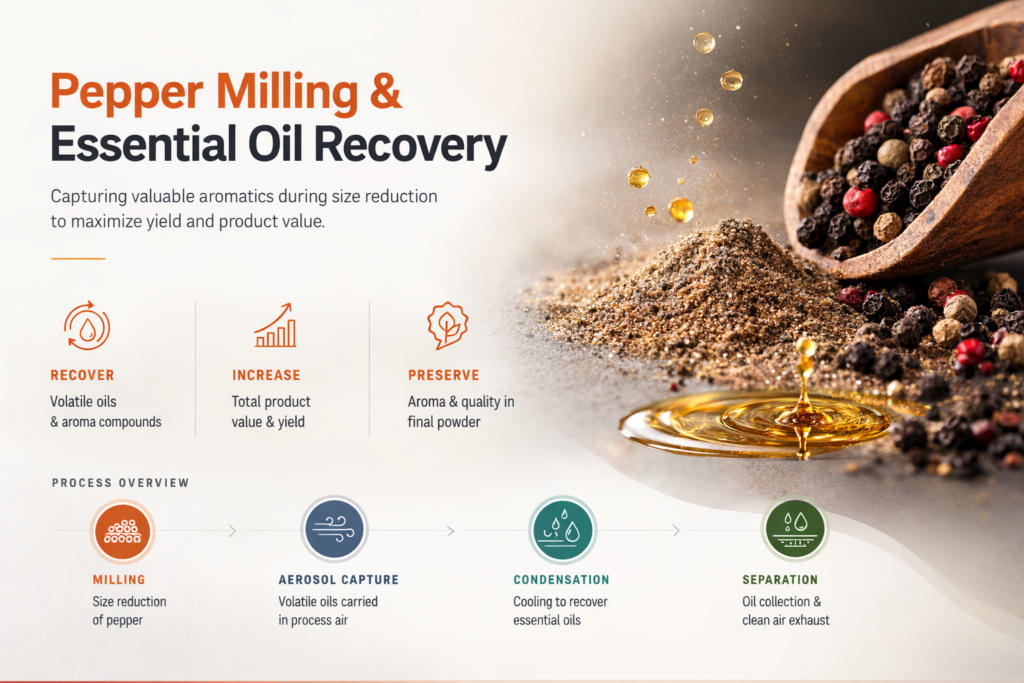
Pepper Milling & Essential Oil Recovery
Grinding peppers is a bit like opening a tiny chemical vault. Inside every dried pepper cell are volatile aromatic compounds—capsaicinoids, terpenes, and essential oils that give peppers their aroma and flavor. When you mill the material aggressively (especially with high-impact mills like pin mills or turbo mills), you rupture those cells and the oils escape. Some stay on the powder, but a surprising amount leaves the system as oil vapor and aerosols carried in the process air.
That means if you want to recover the oils, you essentially need to treat the milling system like a miniature essential-oil distillation plant hiding inside a grinder.
There are three practical industrial approaches.
1. Cyclone + Condensation (Most Common Industrial Method)
In many spice and botanical milling systems, the process air leaving the mill contains:
• fine pepper powder
• oil mist
• volatile aromatic compounds
A standard cyclone will remove most of the powder, but not the oils. To capture the oils you add a condensation stage after the cyclone.
The flow looks like this:
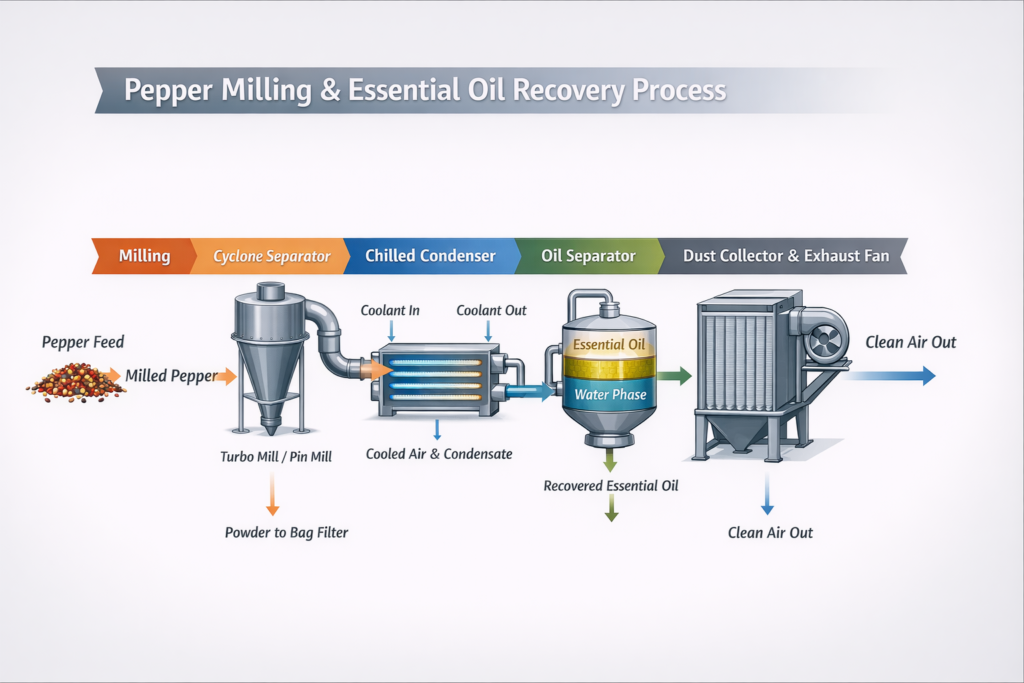
Mill → Cyclone → Condenser → Oil Collection Tank → Exhaust Fan
Here is what happens scientifically:
- The hot air leaving the mill carries volatile oils in vapor form.
- When that air hits a cooled condenser (10–20°C) the vapor condenses.
- The condensate separates into oil and water fractions.
This is basically the same physics used in steam distillation of essential oils, except the vapor source is the milling process rather than steam.
Recovered oils can then be collected in a separation vessel or Florentine separator.
For pepper processing this works surprisingly well because pepper oils are relatively volatile.
2. Cryogenic Milling + Oil Trap (High Value Products)
If Naturaextracta wants maximum aroma retention, cryogenic milling is often the superior route.
In cryogenic grinding:
- Liquid nitrogen cools peppers to –80 to –120°C
- Oils remain trapped in the solid matrix
- Volatile loss is minimized
Then the exhaust nitrogen stream can pass through:
Cold Trap / Cryogenic Condenser
This captures:
• essential oils
• oleoresins
• aroma compounds
This method is used in premium spice processing and pharmaceutical botanical extraction because it preserves delicate flavor compounds.
3. Oil Mist Filtration (For Aerosolized Oils)
Some pepper oils don’t vaporize—they leave as fine oil mist droplets.
In this case a coalescing filter or electrostatic oil mist collector can recover them.
These devices work by forcing tiny droplets to collide and combine into larger drops that fall into a collection sump.
Common in:
- food aroma recovery
- pharmaceutical botanical extraction
- nutraceutical processing
The Best Process Concept for Pepper Milling
For a commercial pepper milling system (like what DP Pulverizers would typically supply), the ideal configuration looks like this:
Pepper Feed → Mill → Cyclone → Condensing Heat Exchanger → Oil Separator → Bag Filter
Benefits:
• recovers valuable essential oils
• improves powder yield
• reduces odor emissions
• increases product aroma quality
The oils recovered are essentially pepper oleoresins, which can be extremely valuable depending on capsaicin content.
In fact, in the spice industry these oils are often worth more per kilogram than the powder itself.
A Curious Detail About Pepper Milling
Black pepper contains 2–4% essential oil and 5–10% oleoresin compounds.
During aggressive milling, as much as 20–30% of the volatile aroma fraction can escape with the air stream if it isn’t captured.
Which means if Naturaextracta is processing 1 ton of pepper, there could be 10–30 kg of recoverable aromatic compounds in the exhaust stream.
That’s not waste. That’s a secondary product.
Nature rarely wastes chemistry. Industrial process design just needs to catch it.
What I Would Recommend for Naturaextracta
A practical system would be:
DP Turbo Mill or Pin Mill → Cyclone → Chilled Condenser → Essential Oil Separator → Dust Collector
This setup allows them to:
- mill peppers efficiently
- collect high-value essential oils
- maintain clean exhaust air
- increase total product yield
And it transforms what most processors treat as a nuisance (pepper smell in the exhaust) into another revenue stream.